

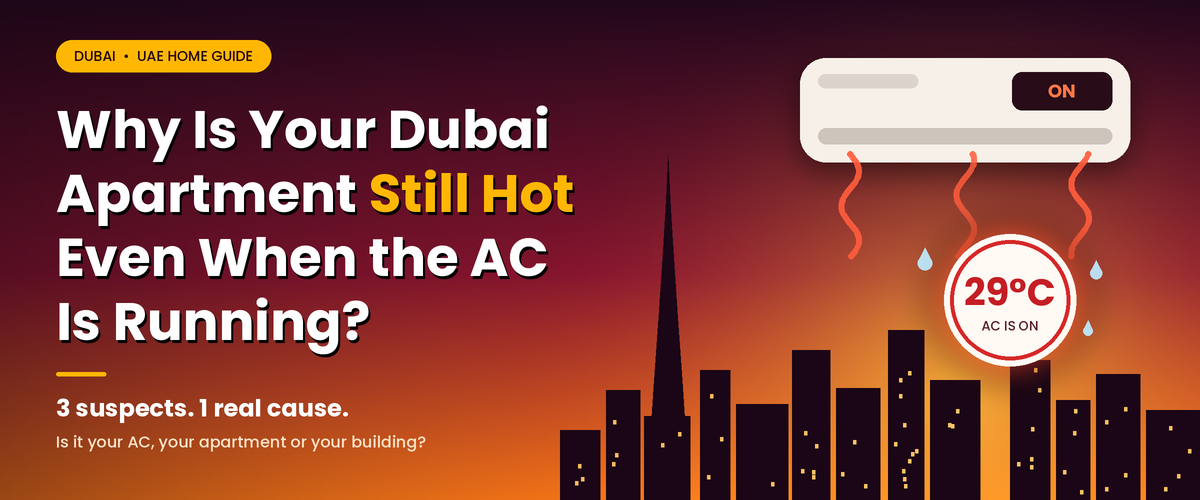
It’s 2 am. The AC has been running since morning, and you’re lying on top of the sheets, sweating. You’ve set it to 18°C. The room still reads 29°C. You’re already dreading the bill, and a small voice asks: Am I being dramatic?
You’re not. And your AC might not be broken either.
Dubai’s airport weather station has hit 48.8°C in August, and one technical manager quoted by Gulf News says a perfectly healthy AC may only get a home down to about 26°C on the worst days. Sometimes the machine isn’t failing you. It’s just losing a fight with the heat.
This guide shows which of three suspects is to blame: the AC, your apartment or your building. It applies from Dubai to Sharjah, Abu Dhabi and Al Ain.
Why Summer Beats Most UAE Apartments
Your AC moves heat, it doesn’t make cold
It pulls heat out of indoor air and pushes it outside. When heat enters faster than the unit removes it, the room stays warm even though the AC works perfectly.
The UAE’s double squeeze
Inland cities like Abu Dhabi and Al Ain bring raw heat. Coastal Dubai and Sharjah add humidity. Dubai’s peak average humidity is 72% in August and 78% in September, which is why September feels just as brutal.
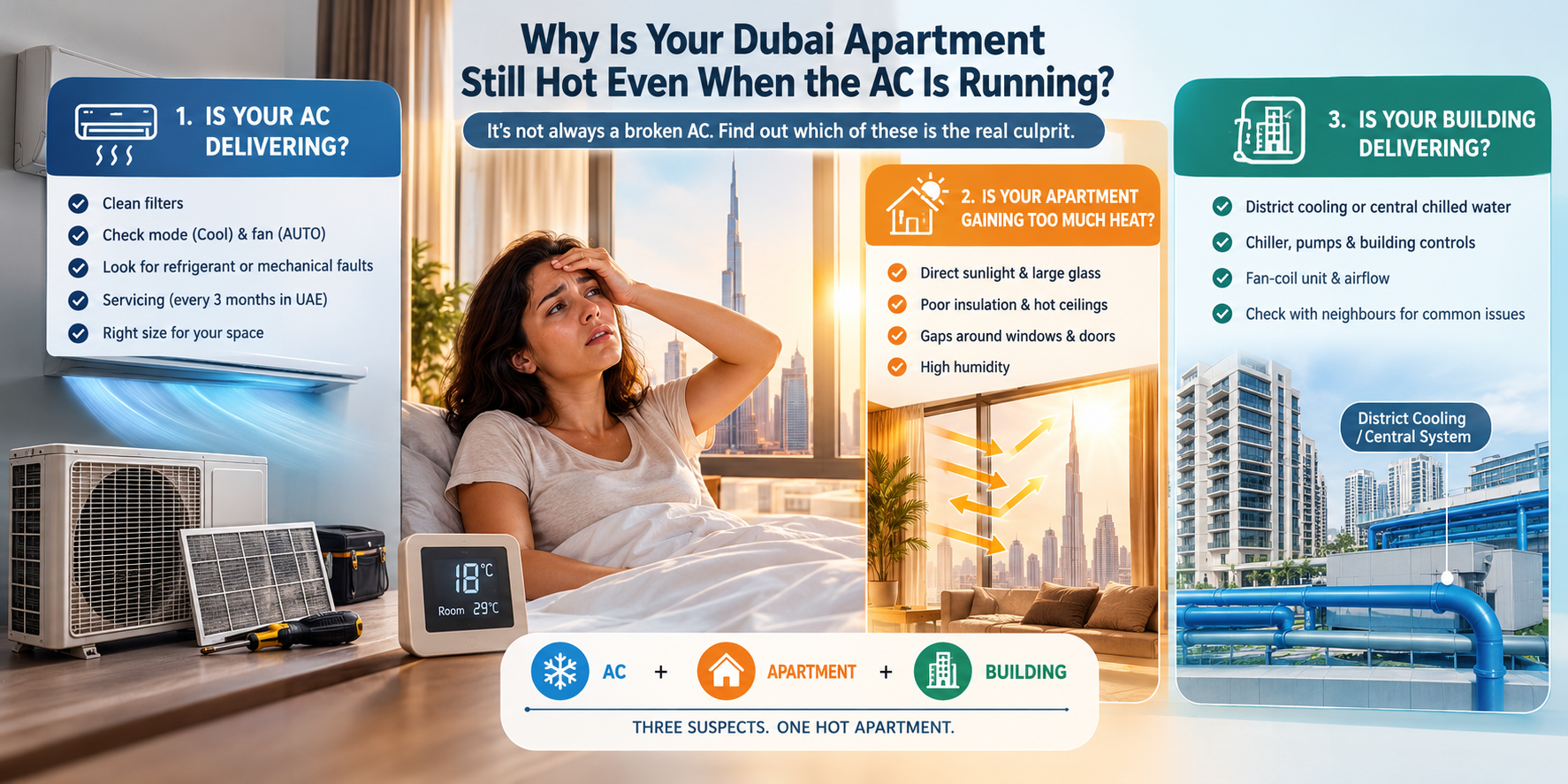
The three-question test
Ask: Is the AC delivering? Is my flat gaining too much heat? Is the building delivering? Everything below sorts into those three. Reality check: most UAE systems are designed to cool only 15-20°C below outdoor temperature, so a 45°C afternoon caps even a healthy unit.
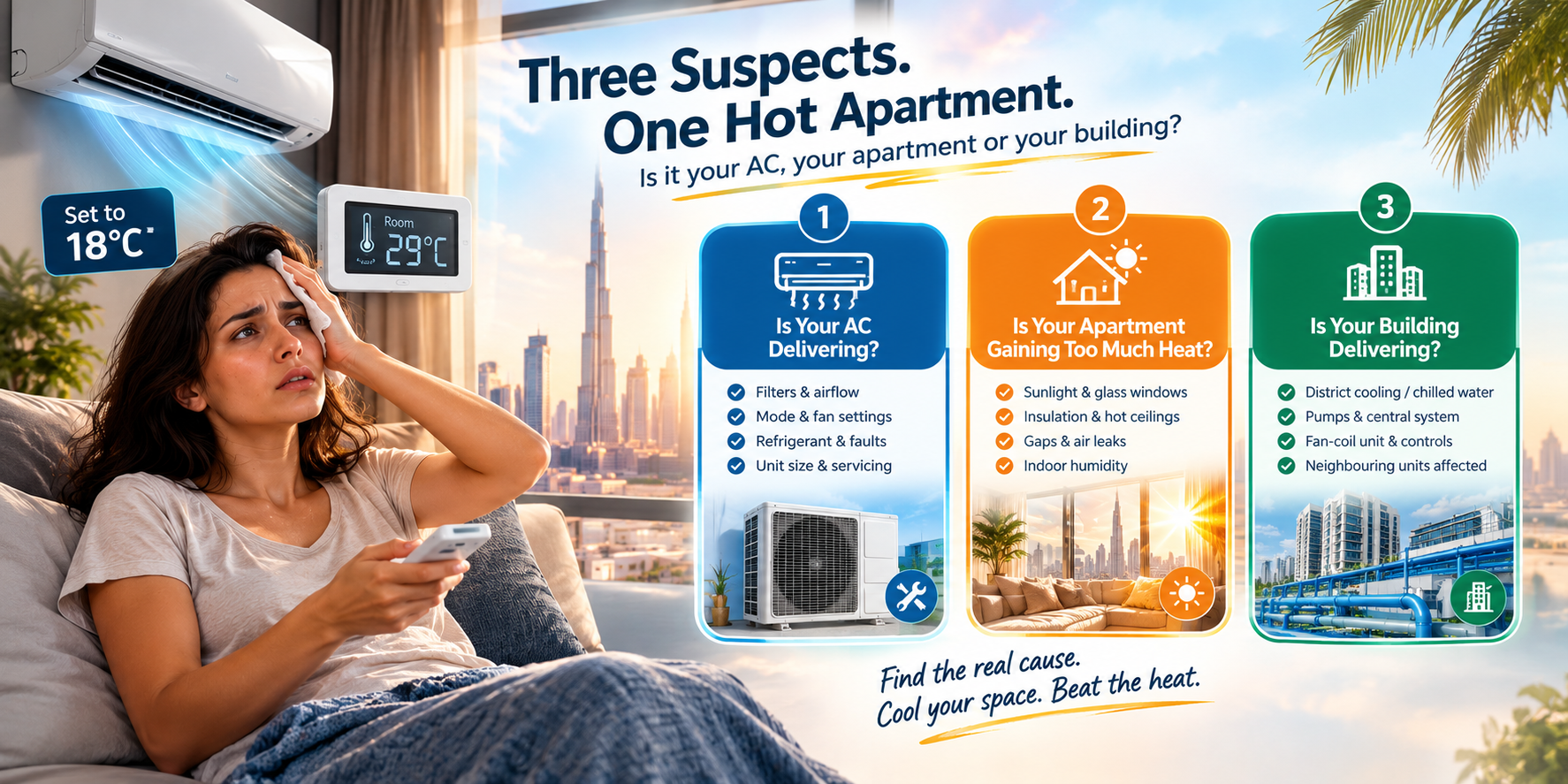
Suspect 1: Is Your AC Delivering?
Filters, mode and fan setting
DEWA says to clean filters at least monthly in summer. How: switch the unit off, slide the filter out, rinse it in lukewarm water, dry it completely, refit it. Then check the mode says cool and the fan is on AUTO, since a constantly running fan can push moisture back into the room.
Gas refills and real faults
Warm or weak air can mean low refrigerant, a failing compressor or a clogged filter. Don’t request a “gas top-up” by reflex. A refill without finding the leak is a pricey reset, so ask the technician where the leak is, in writing. Ice on the unit can come from restricted airflow too, not only refrigerant.
Old, undersized or sun-baked units
Units over eight to ten years old without regular servicing underperform most, and one operations head recommends servicing every three months here. An outdoor unit baking on a sunny balcony can overheat and lose efficiency. Before agreeing to a bigger unit, ask for a cooling-load calculation. Right-sizing is the fix, not size.
Suspect 2: Is Your Apartment Gaining Too Much Heat?
Glass that cooks the room
West-facing glass with no window film dumps afternoon heat inside. Blackout curtains help, and DEWA also lists shades, awnings and reflective materials. Ask building management before fitting film.

Leaks and hot ceilings
Gaps around windows and balcony doors let humid air in, so the AC spends energy drying air instead of cooling it. On top floors, cooled air in hot ceiling ducts can warm up before reaching you. DEWA’s fix: weatherstripping and caulking around doors and windows.
Which fix is worth it?
| Fix | Cost-to-value | Hidden risk | Common myth |
|---|---|---|---|
| Clean filters | Very high | Refitting damp filters | “Once a year is fine” |
| Weatherstripping | High | Poor fit jams balcony doors | “I need a new AC” |
| Blackout curtains | High | Blocking vents | “Curtains don’t matter” |
| Window film | Medium | Needs building approval | “Any film works” |
| Bigger AC | Low unless sized | Needs a proper load calculation | “Bigger is always better” |
Suspect 3: Is Your Building Delivering?
Know your system first
Not every UAE flat uses district cooling. Ask your agent which provider serves the tower, look for a provider logo in the utility cupboard, or search the tower name plus “Empower.”
How chilled-water cooling works
A central plant chills water and sends it through insulated underground pipes to your building. Your fan-coil unit blows air across that water. Empower, Emicool and Tabreed are the big operators. In a Dubai “chiller-free” tenancy, you still pay DEWA for the fan coils, so ask exactly what that term covers.
Spotting a shared problem
Weak chilled-water flow or lower chiller efficiency can hit several units in one section of a building. Knock on two neighbours’ doors. If they feel it too, report it to building management, not a technician. If it’s only you, you need a pro. AddressGuru UAE is a business directory listing multiple businesses on its website, so it’s a handy place to start a shortlist of AC service companies in your emirate. Get two written quotes before you commit.
Match the Symptom to the Culprit
| Symptom | Likely suspect | First move |
|---|---|---|
| Weak airflow | AC | Filter, then vents |
| Warm air from vents | AC or building | Check mode, ask neighbours |
| Cool at 9 am, hot after 2 pm | Apartment | Curtains, seals |
| One room hot | Airflow or sun | Clear vents, close curtains |
| Sticky, damp air | Humid leaks | Seal gaps, fan on AUTO |
| Neighbours too | Building | Written report |
AC clues
Weak air, ice or odd noises point to the unit itself, not your flat.
Apartment clues
Heat that tracks the sun points to glass, walls and ceilings.
Building clues
Neighbours with the same complaint? Send building management a written report with your heat log before paying for repairs.
What to Check Before You Call Anyone
The ten-minute checklist
Mode on cool, fan on AUTO, filter clean, vents clear, doors and balcony shut, curtains drawn on sunny glass. If the air still feels lukewarm, clean the outdoor condenser coils too. Leave electrical parts alone. A ceiling fan helps: DEWA says fans use little electricity and make higher settings feel comfortable.
Build a heat log
For a week, note room temperature at 8 am, 2 pm and 8 pm using the same thermometer in the same spot. Add the set temperature and whether neighbours are affected. That log is your evidence for landlords, building managers and technicians.
Why lowering the thermostat backfires
DEWA recommends 24°C and says each degree higher saves up to 5% on AC consumption. Dropping to 18°C won’t fix leaks or a weak chilled-water supply. It just runs the AC longer and raises your bill. Treat 24°C as efficiency guidance, not a promise.
Who Pays and What Can Go Wrong
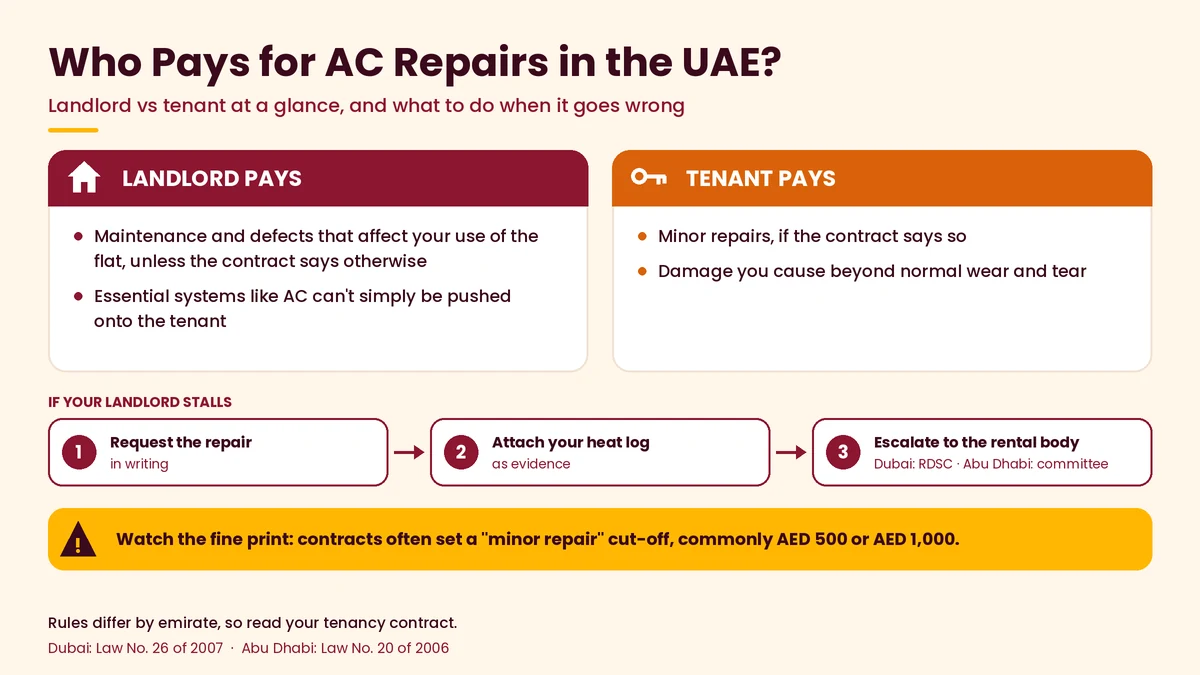
Landlord or tenant?
| Dubai | Abu Dhabi | |
|---|---|---|
| Law | Law No. 26 of 2007 | Law No. 20 of 2006 |
| Landlord | Maintenance and defects affecting use, unless agreed otherwise | “Necessary repairs” |
| Tenant | Minor repairs, plus damage they cause | “Rental repairs” |
| If landlord stalls | Rental Disputes Settlement Centre | Committee can approve self-repair, rent reduced by the cost |
Other emirates have their own rules, so read your contract.
Traps that cost tenants money
Contracts often set a cost cut-off for “minor” repairs, commonly AED 500 or AED 1,000, so check yours before signing. A landlord can’t dump essential systems like AC on you, or refuse a repair over an unproven misuse claim. Request repairs in writing. In Abu Dhabi, written notice comes before any committee case.
Red flags that need a pro today
Ice on the unit, strange noises or lukewarm vents need a technician. Water leaks and repeated shutdowns do too. A burning smell means switch it off and call maintenance. Children, older adults and people with heart or breathing conditions face higher risk from prolonged indoor heat, so don’t wait.
The Bottom Line
Find the cause before you touch the thermostat or pay for a refill. Run the three-question test, keep your heat log and put every request in writing. A hot flat with a working AC is rarely a mystery once you know which suspect to question.