

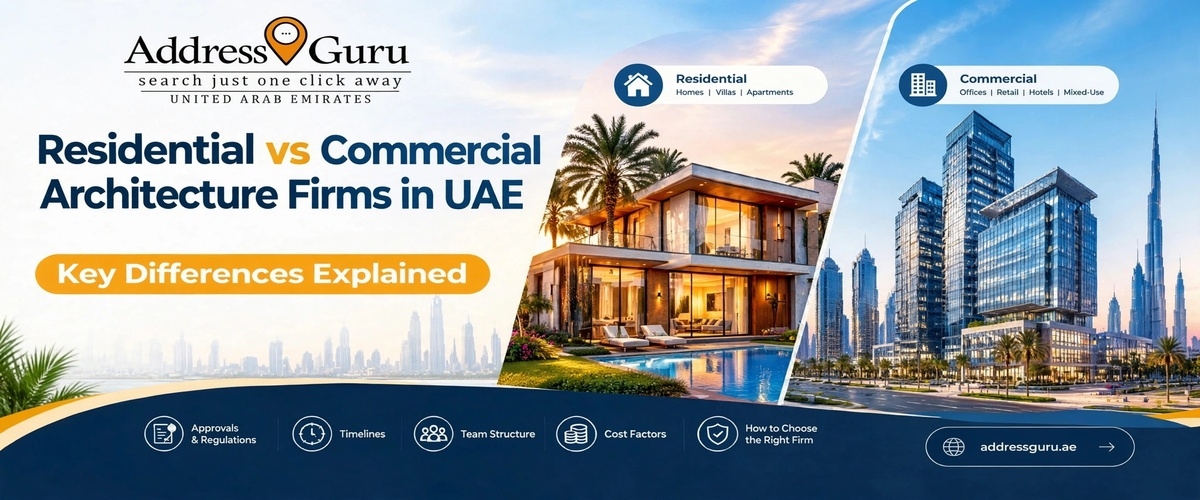
Choosing between residential and commercial architecture firms in the UAE is one of the most overlooked decisions in any construction project — and one of the costliest to get wrong. A firm that designs beautiful villas may struggle with fire-safety compliance on a retail tower, while a commercial specialist may miss the personal touches a family home needs.
This guide breaks down the practical differences between the two, based on how projects actually move through design, approval, and construction in the UAE — so when you compare residential vs commercial architecture firms, you can choose with confidence rather than guesswork.
Residential Architecture Firms: Built Around the Homeowner

Residential architecture firms in Dubai and across the UAE design homes, villas, and apartments with one central focus: how people actually live day to day.
This is one of the biggest differences that shows up when comparing residential vs commercial architecture firms — the process typically starts with detailed conversations about family size, privacy needs, entertaining habits, and future plans, not just floor plans.
In the UAE, this usually means designing around:
- Community and homeowner association (HOA) guidelines, which vary significantly between developments like Emirates Hills, Arabian Ranches, or Yas Island
- Majlis and family-gathering spaces, which follow cultural norms distinct from Western-style layouts
- Climate-responsive design, including shading, courtyard airflow, and heat-resistant materials suited to the region
Because approvals here go through community developer guidelines and municipality residential codes rather than heavier commercial frameworks, timelines are often shorter and the design process more flexible. This is one of the clearest practical gaps when weighing residential vs commercial architecture firms for a project.
Good residential firms also tend to stay involved past the design phase — coordinating with contractors, adjusting layouts during construction, and handling last-minute changes a family requests once they see the space taking shape.
This ongoing involvement is one of the clearest signs of a firm that genuinely understands residential clients, rather than one simply producing drawings and moving on.
Commercial Architecture Firms: Built Around the Business Case
Commercial architecture firms handle offices, retail spaces, hotels, and mixed-use towers, where design decisions are driven by business performance, safety codes, and long-term operational efficiency — not personal taste. This is the other half of the residential vs commercial architecture firms equation, and it operates under a very different rulebook.

This is where regulatory depth matters most. Commercial projects in the UAE typically require sign-off from multiple authorities, including:
- Dubai Civil Defence (DCD) for fire and life-safety compliance
- Trakhees or the relevant free zone authority, if the project sits within a designated zone
- Dubai Municipality or the respective emirate's planning department for structural and zoning approval
- Estidama in Abu Dhabi, for sustainability compliance on qualifying projects
Firms working confidently across these frameworks tend to be the ones repeatedly listed among the top architecture firms in Dubai and among the best architecture firms in Dubai, simply because navigating this complexity without delays takes real, proven experience — not just design talent.
Beyond approvals, commercial design also has to account for footfall patterns, wayfinding, and how a space performs years after opening — not just how it looks on handover day.
A well-designed retail unit is judged on whether it still functions efficiently during peak hours two years later, which is why experienced architecture companies in Dubai often involve operations input early in the design process, not as an afterthought.
Residential vs Commercial Architecture Firms: Side-by-Side Comparison
The table below sums up how residential vs commercial architecture firms differ across the factors that matter most in a UAE project:
| Factor | Residential Firms | Commercial Firms |
|---|---|---|
| Core Focus | Family lifestyle, comfort, privacy | Business function, safety, brand identity |
| Key Approvals | HOA guidelines, municipality residential codes | Civil Defence, free zone authorities, Estidama |
| Typical Timeline | 3–9 months (design to permit) | 6–18+ months (design to permit) |
| Team Structure | Small, closely involved design team | Multi-disciplinary team (MEP, structural, safety) |
| Cost Drivers | Built-up area, finishes, customization | Scale, code compliance, engineering coordination |
What This Means for Your Budget
Neither category is automatically more expensive — a large custom villa can easily cost more than a small office fit-out. What actually drives cost is scope: residential pricing tracks closely with built-up area and finish quality, while commercial pricing carries added weight from structural engineering, MEP coordination, and compliance consultants. Understanding this early keeps expectations realistic on either side of the residential vs commercial architecture firms comparison.
The most reliable way to budget accurately is to request itemized quotes from two or three architecture companies in Dubai before committing, rather than relying on a single ballpark figure. This step matters just as much whether you're weighing residential vs commercial architecture firms for a villa or a full commercial fit-out.
Signs of a Trustworthy Architecture Firm
Not every firm advertising itself as experienced actually has the track record to back it up — and this applies equally on both sides of the residential vs commercial architecture firms divide.
Before signing a contract, it's worth checking for a few concrete markers of credibility:
- Valid trade licenses and RERA or municipality registration, which any legitimate firm should share without hesitation
- A traceable portfolio — completed projects you can visit or verify, not just rendered concept images
- Clear, written scope of work, including who handles approvals, engineering, and site supervision
- Transparent fee structure, with no vague "final cost to be discussed later" clauses
Firms that hesitate to provide any of the above are worth reconsidering, regardless of how polished their website or portfolio looks.
How to Choose Between Residential vs Commercial Architecture Firms
Once you've weighed the differences above, here's how to put that into a decision:
- Match the portfolio to your project type — a firm's best villa project tells you little about its ability to handle a retail rollout, and vice versa.
- Verify hands-on approval experience — ask specifically which authorities they've secured sign-off from in the past 12–24 months, since this reveals current, not outdated, expertise.
- Assess team depth, not just design flair — commercial work in particular needs structural, MEP, and safety specialists in-house or on retainer.
- Talk to past clients directly — a short call with a previous client often reveals more than any portfolio page about how a firm handles delays or budget changes.
- Compare communication style early — some of the best architecture firms in Dubai and top architecture firms in Dubai are highly responsive but slower to deliver detailed documentation, so decide what matters more for your timeline.
Final Thoughts
When it comes to residential vs commercial architecture firms, the right choice comes down to matching your project's purpose to a firm's actual specialty — not just its size or reputation.
For a home, prioritize firms with strong residential portfolios and a personal design process. For a business space, prioritize firms with proven regulatory experience and cross-functional teams.
Take the time to verify recent, relevant project experience before signing on with any architecture firms in Dubai or architecture companies in Dubai. It's the single factor that most consistently separates smooth builds from delayed, over-budget ones.