

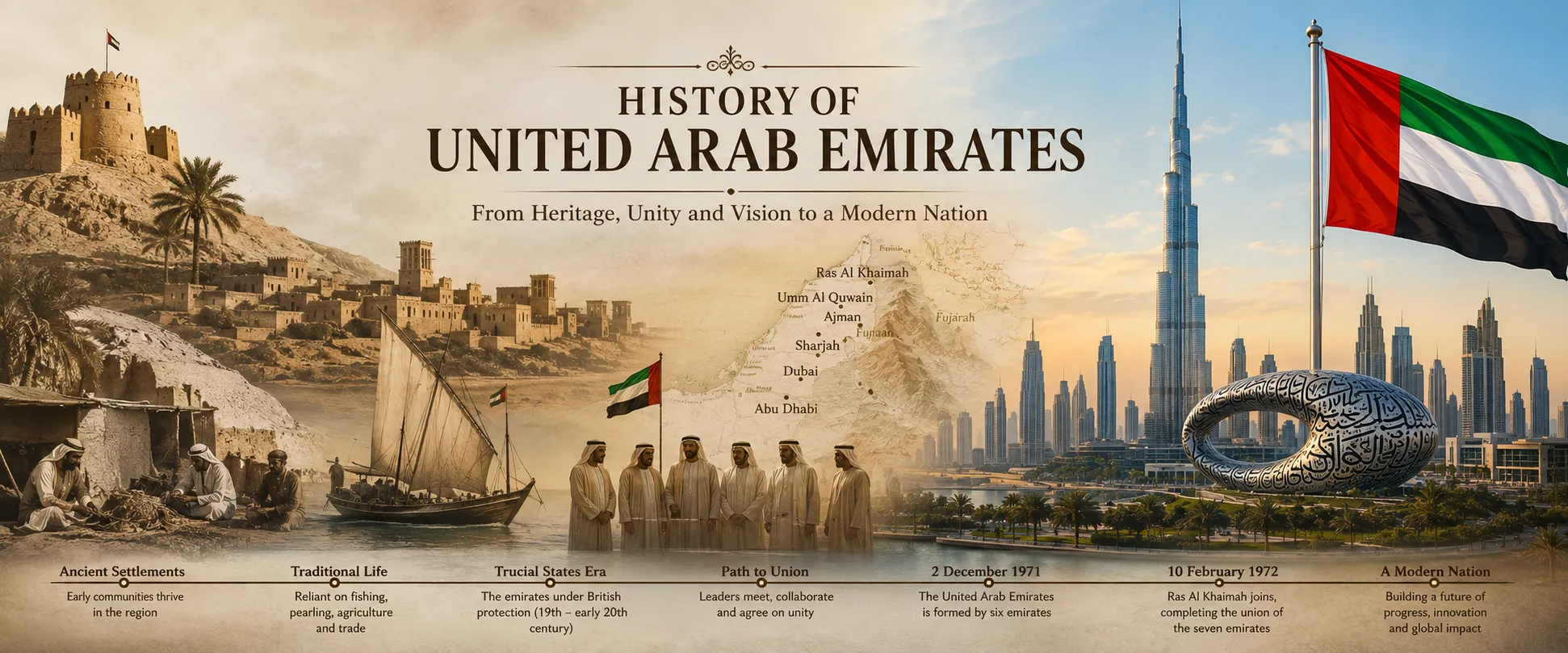
The history of United Arab Emirates is a story of ancient settlements, maritime trade, pearling, tribal communities, local rulers, and eventually the formation of one of the world's most recognizable federations. Long before the modern UAE was established, the region was home to communities whose lives were closely connected to the sea, desert, agriculture, trade, and oasis settlements.
Today, the UAE consists of seven emirates: Abu Dhabi, Dubai, Sharjah, Ajman, Umm Al Quwain, Fujairah, and Ras Al Khaimah. Each emirate developed its own identity and history before becoming part of the federation.
Understanding the history of UAE therefore means looking not only at the country's formation in 1971 but also at the individual stories of the seven emirates.
Early History of the UAE
The history of the region goes back thousands of years. Archaeological evidence suggests that people were living in what is now the UAE as early as around 6000 BC. Early communities depended on fishing, hunting, gathering, agriculture, and animal grazing.
Archaeological discoveries across Abu Dhabi, Sharjah, Umm Al Quwain, and Ras Al Khaimah provide evidence of these early settlements. Later periods, including the Bronze Age and Iron Age, saw the development of agriculture, metalworking, trade, and irrigation systems.
The region's position between the Arabian Peninsula, the Indian Ocean, and the wider Gulf also made it an important location for maritime trade. Over centuries, coastal communities developed strong connections with traders and settlements across the region.
The Trucial States Before the UAE
Before the United Arab Emirates existed as a country, the seven emirates were independent sheikhdoms. They became known collectively as the Trucial States during the period of British influence in the Gulf.
The coastal economy relied heavily on fishing, pearling, maritime trade, agriculture, and regional commerce. The sea was particularly important to communities in places such as Abu Dhabi, Dubai, Sharjah, and Ras Al Khaimah.
From the 19th century, Britain entered into a series of agreements with the rulers of the coastal states. In 1892, the rulers entered into Exclusive Agreements that placed their external relations under British protection. Britain later announced its intention to withdraw from the Gulf by the end of 1971.
This change eventually created the opportunity for the emirates to pursue a new political arrangement.
History of the Seven Emirates
The UAE's modern identity was built from seven emirates, each with its own historical journey.
1. History of Abu Dhabi

Abu Dhabi is the largest emirate and became the federal capital when the UAE was formed. Its history is strongly connected with the sea, oasis settlements, fishing, pearling, and trade.
For generations, communities in Abu Dhabi depended on the Arabian Gulf for food, transportation, and commerce. Pearling became particularly important to the local economy, with traditional dhow voyages taking pearl divers into the Gulf. Al Ain, within the emirate, also developed around oases and underground water sources, supporting agriculture and settlement.
The discovery of oil transformed Abu Dhabi's economic prospects during the 20th century. Under Sheikh Zayed bin Sultan Al Nahyan, who became Ruler of Abu Dhabi in 1966, the idea of greater unity between the emirates became increasingly important.
Sheikh Zayed played a central role in discussions that eventually led to the formation of the UAE and became the country's first President in 1971.
Today, Abu Dhabi is the political capital of the UAE and remains central to the country's federal institutions.
2. History of Dubai

The history of Dubai is often associated with its transformation from a small coastal settlement into a global business and tourism centre.
The Al Maktoum family established its rule in Dubai in 1833, when the settlement was still heavily dependent on fishing, pearling, and maritime trade. Dubai's location along important Gulf trading routes helped it develop commercial connections with merchants from different regions.
During the late 19th and early 20th centuries, pearling and maritime commerce became important parts of Dubai's economy. The emirate also developed a reputation as a trading centre.
A major period of development began under Sheikh Rashid bin Saeed Al Maktoum, who became Ruler of Dubai in 1958. His leadership helped expand infrastructure, trade, and economic activity. Oil was discovered in Dubai in 1966, providing additional resources for development, while the emirate increasingly diversified into shipping, finance, tourism, and commerce.
Dubai also played a crucial role in the formation of the UAE. Sheikh Rashid worked closely with Sheikh Zayed, and the two leaders reached an important agreement in February 1968 that helped advance the idea of federation.
3. History of Sharjah
Sharjah has a long history connected with education, culture, trade, agriculture, and maritime activity. Archaeological discoveries in the emirate provide evidence of settlements dating back thousands of years.
The emirate's location along the Gulf and its access to the east coast gave it an important position in regional trade. Historic areas such as Al Dhaid also demonstrate the importance of agriculture, water systems, and caravan routes in Sharjah's past.
Sharjah was also historically associated with the Qasimi ruling family and played a significant role among the Trucial States.
Its historical importance continued into the modern period, particularly through education and cultural development. Today, Sharjah is widely recognized for its museums, heritage areas, libraries, cultural institutions, and preservation of Emirati traditions.
Sharjah was one of the six emirates that joined the UAE at its establishment on 2 December 1971.
4. History of Ajman
Ajman is the smallest of the seven emirates, but its history is closely connected with the traditional coastal economy of the region.
For generations, communities in Ajman relied on fishing, pearling, boat building, agriculture, and trade. Like the other coastal emirates, Ajman was part of the Trucial States before the creation of the UAE.
The emirate experienced important development during the 20th century as infrastructure, education, healthcare, and government institutions expanded. The ruling Al Nuaimi family played an important role in this development.
Ajman joined the federation along with Abu Dhabi, Dubai, Sharjah, Umm Al Quwain, and Fujairah on 2 December 1971.
Although much smaller than Abu Dhabi or Dubai, Ajman's location and connection to the northern emirates have made it an important part of the UAE's economic and social landscape.
5. History of Umm Al Quwain
The history of Umm Al Quwain is strongly connected with fishing, seafaring, agriculture, and life along the coast.
Archaeological evidence indicates that the wider region has been inhabited since ancient times. Discoveries in Umm Al Quwain include pottery associated with early settlements dating back thousands of years.
The emirate remained relatively small and relied heavily on traditional activities such as fishing and maritime trade. Its coastal environment and islands supported communities whose lifestyles were closely connected with the sea.
During the 20th century, Umm Al Quwain gradually developed modern schools, healthcare facilities, roads, and government services. Sheikh Ahmed bin Rashid Al Mualla, who became ruler in 1928, oversaw several important developments, including the establishment of the emirate's first school and hospital.
Umm Al Quwain became one of the six founding members of the UAE federation on 2 December 1971.
6. History of Fujairah
Fujairah has a distinctive place in the history of UAE because it is the only emirate located entirely on the UAE's eastern coast, along the Gulf of Oman.
Its history reaches back thousands of years, with evidence of communities relying on fishing, herding, agriculture, and trade. Its position near the Hajar Mountains and the Gulf of Oman gave Fujairah a different geographical and economic character from the western coastal emirates.
The emirate's history includes forts, traditional settlements, agricultural communities, and maritime activity. Fujairah's separate identity was formally recognized by Britain in 1952 under Sheikh Mohammed bin Hamad Al Sharqi.
Under Sheikh Mohammed, the emirate also saw the development of education, roads, healthcare, and other basic infrastructure.
Fujairah joined the other five founding emirates in establishing the UAE on 2 December 1971.
7. History of Ras Al Khaimah
Ras Al Khaimah has one of the richest archaeological landscapes among the emirates. Its history stretches back thousands of years, with archaeological evidence showing long-term settlement, trade, agriculture, and maritime activity.
Its location in the northern part of the UAE, close to the Hajar Mountains and the Strait of Hormuz, gave it strategic importance for regional trade.
The emirate was historically associated with the Qasimi ruling family and was one of the Trucial States. Its traditional economy included fishing, agriculture, trade, and maritime activities.
Under Sheikh Saqr bin Mohammed Al Qasimi, who became ruler in 1948, the emirate expanded education, infrastructure, and public services. Ras Al Khaimah did not join the UAE on 2 December 1971. Instead, it formally joined the federation on 10 February 1972, completing the union of the seven emirates.
How Was the UAE Formed?
The formation of the UAE was the result of years of discussions and cooperation between the emirates.
A major turning point came on 18 February 1968, when Sheikh Zayed bin Sultan Al Nahyan and Sheikh Rashid bin Saeed Al Maktoum met at Al Samha, between Abu Dhabi and Dubai. They agreed to work toward a federation.
Later that month, the rulers of the Trucial States met in Dubai and agreed on an 11-point framework that became an important foundation for the federation project.

In 1968, Britain also announced its intention to withdraw from the Gulf by the end of 1971. This created a new political situation and increased the importance of cooperation among the emirates.
On 18 July 1971, the rulers of six emirates — Abu Dhabi, Dubai, Sharjah, Ajman, Umm Al Quwain, and Fujairah — agreed to establish the United Arab Emirates.
Then, on 2 December 1971, the UAE was officially established as an independent sovereign federation.
Ras Al Khaimah joined the federation on 10 February 1972, completing the union of all seven emirates.
The Role of Sheikh Zayed in the Formation of the UAE
Any discussion of the history of United Arab Emirates would be incomplete without mentioning Sheikh Zayed bin Sultan Al Nahyan.
As Ruler of Abu Dhabi from 1966, Sheikh Zayed strongly supported the idea that cooperation between the emirates could create a stronger and more prosperous nation.
His partnership with Sheikh Rashid bin Saeed Al Maktoum was particularly important. Together, they helped move the idea of federation from discussion toward reality.
After the UAE was established, Sheikh Zayed became its first President and remained in that position until his death in 2004. He is widely regarded as the founding father of the UAE.
The UAE After 1971
The formation of the federation was only the beginning of the country's transformation.
The new UAE government began developing national institutions while the individual emirates continued to manage many local matters. The UAE Constitution established the framework for dividing responsibilities between the federal government and the emirates.
Infrastructure expanded rapidly. Roads, schools, hospitals, ports, airports, housing, and public services developed across the country.
Oil revenues provided important financial resources, particularly in Abu Dhabi, while Dubai and the other emirates increasingly diversified their economies.
Over the decades, the UAE expanded beyond its traditional industries and developed strong sectors in tourism, aviation, logistics, finance, real estate, manufacturing, technology, and international trade.
The provisional Constitution adopted in 1971 became permanent in 1996, establishing the long-term constitutional framework of the federation.
From Seven Emirates to a Global Country
The modern UAE is the result of both shared identity and individual histories.
Abu Dhabi contributed its political importance and energy resources. Dubai developed into an international centre for trade, tourism, finance, and logistics. Sharjah built a strong cultural and educational identity. Ajman, Umm Al Quwain, Fujairah, and Ras Al Khaimah each developed their own economic and cultural strengths.
Together, the seven emirates created a federation that preserved local identities while building a shared national framework.
Today, the UAE remains a constitutional federation of seven emirates, with federal and local governments working within the framework established by the Constitution.
Final Thoughts
The history of United Arab Emirates is much more than the story of its formation in 1971. It stretches back thousands of years and includes ancient settlements, fishing communities, pearl diving, agriculture, maritime trade, local rulers, and the development of the Trucial States.
The individual stories of Abu Dhabi, Dubai, Sharjah, Ajman, Umm Al Quwain, Fujairah, and Ras Al Khaimah eventually came together to create the modern UAE.
The formation of the federation on 2 December 1971, followed by Ras Al Khaimah's accession in February 1972, marked a defining moment in the country's history. Since then, the UAE has undergone remarkable economic and social transformation while continuing to preserve many elements of its cultural and historical heritage.
Understanding the history of UAE provides a better perspective on how a group of historically distinct emirates developed into one united country while maintaining their individual identities.