


You’ve been saving screenshots of other people’s villas for three years. Now it’s finally your turn, so you open ten portfolios. Every single one looks incredible.
That’s the trap. When every portfolio is beautiful, the portfolio can’t be what decides. The cheapest quote can’t either, because cheap usually means something was left out.
So here’s a better way of comparing architecture firms in the UAE: run every firm through the same checks, in the order that protects your money first. Most pages ranking for architecture firms in UAE stop at top-firm lists. Few explain how approvals differ by emirate, what quotes quietly exclude, or who’s accountable when authorities push back.
1. Check Eligibility Before You Fall for a Portfolio
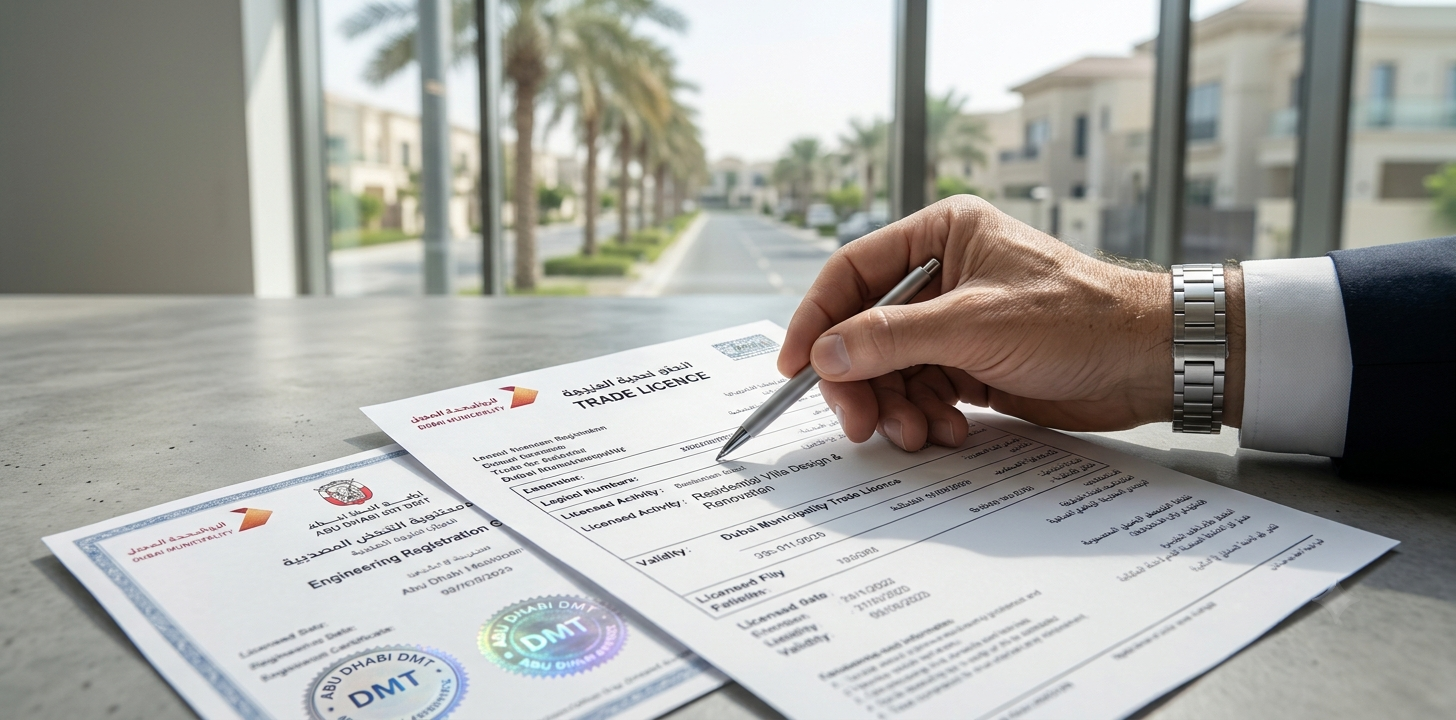
A stunning firm that isn’t cleared to take your project is an expensive detour. The UAE doesn’t run one uniform approval process. Dubai Municipality keeps registration arrangements for consulting engineering offices and contractors. Abu Dhabi’s Department of Municipalities and Transport (DMT) publishes an engineering-firm directory with classification details. Free zones and special developments can add their own procedures.
How to check:
- Ask for the current trade licence and consultancy registration.
- Confirm the licensed activities cover your work: new build, renovation, extension or fit-out.
- Search the firm’s name on the relevant authority’s own list, such as Dubai Municipality’s consultants data page or DMT’s directory. Compare what you find with the paperwork you were given.
- Ask which authority will review your property, then have the firm walk you through that process.
Common mistake: assuming registration or experience in one emirate proves eligibility in another. Get it confirmed in writing.
2. Compare Experience That Matches Your Project
A tower portfolio doesn’t prove someone can renovate a villa well. Test relevance, not volume.

| What to compare | Why it matters | How to test it |
|---|---|---|
| Building type | A fit-out and a villa are different jobs | Ask for two completed projects like yours |
| Authority familiarity | Each authority has its own procedures | Ask about their latest approval in your area |
| Who did the work | Portfolios can credit a whole team | Ask which people delivered it |
One of the best questions to ask an architecture firm: “Tell me about a similar project that hit trouble, and how you fixed it.” A specific answer beats any render.
3. Judge Design by How It Lives, Not How It Looks
Renders don’t sweat. Your building will. Ask each firm why it recommends a layout or material, not just to show it. Look for:
- Space planning and circulation that suit how you live or operate
- Sun exposure, shading, glazing and heat gain, which matter a lot in UAE heat
- Natural light, ventilation and privacy
- Materials you can realistically maintain
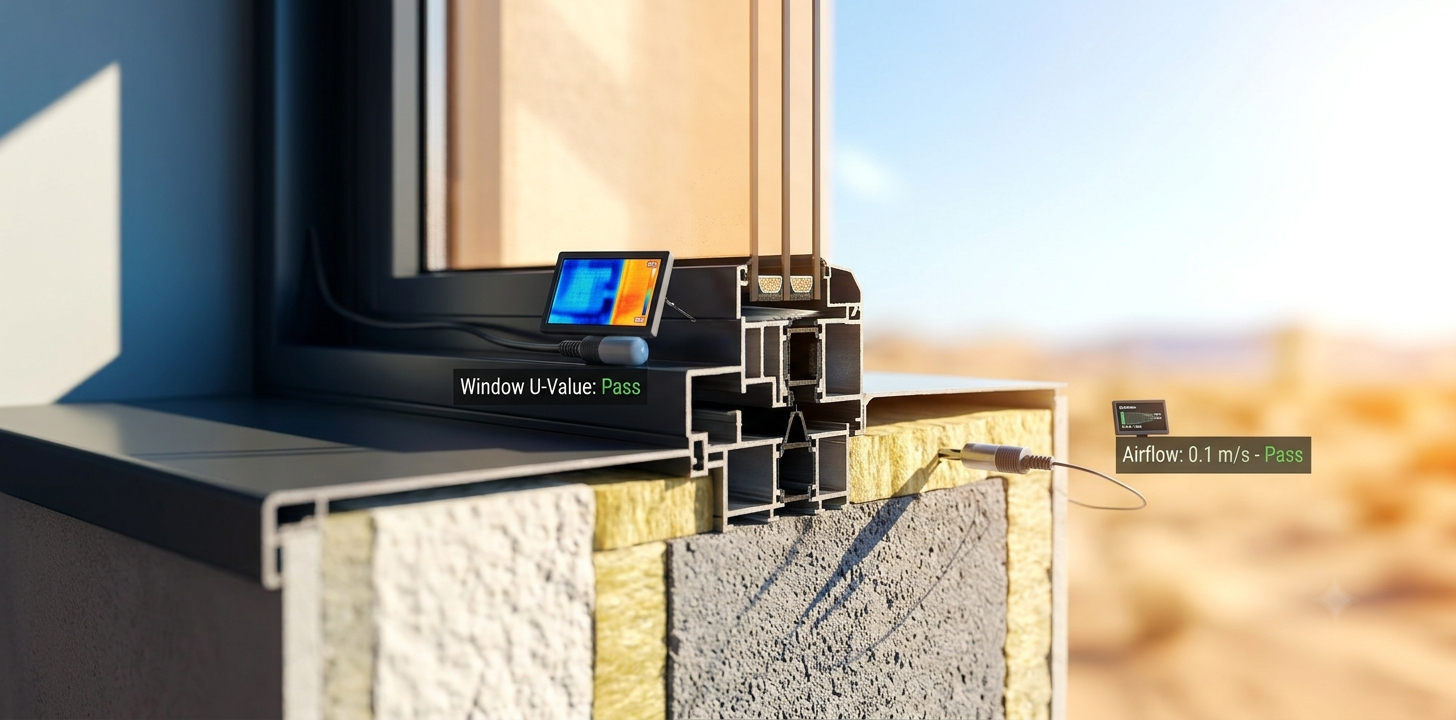
Hidden risk: a glass-heavy façade can photograph beautifully and then raise your cooling load. Ask for the trade-off in plain words.
4. Match the Scope of Services Line by Line
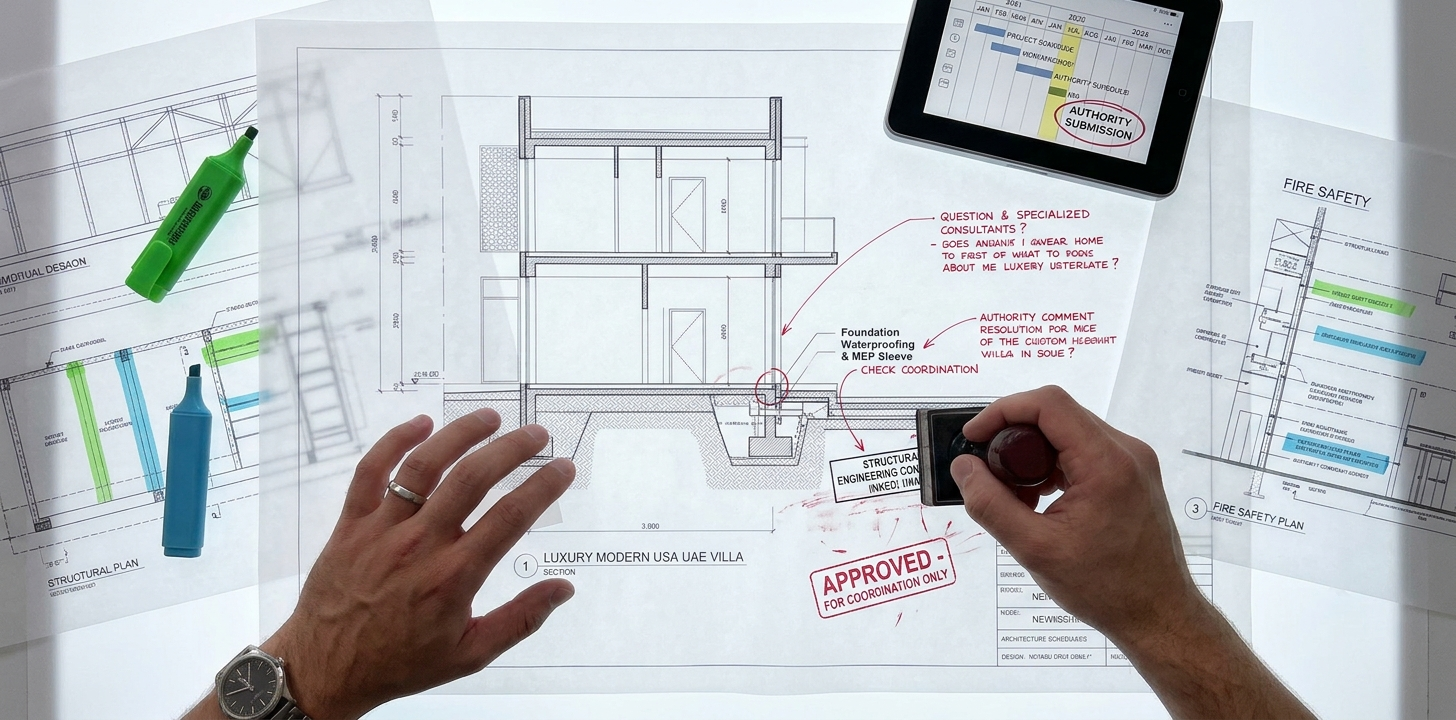
Two proposals can carry the same title and cover very different work. Confirm who handles each stage: site assessment, concept design, detailed drawings, authority submissions and revisions, consultant coordination, tendering and construction-stage support.
Then ask:
- Who prepares and submits drawings to the authority, and who answers its comments?
- Are structural, MEP or fire-safety consultants needed, and who coordinates them?
- What happens if the authority demands design changes?
Hiring a firm doesn’t guarantee approval. It decides who does the work when comments arrive.
| Package type | Cost-to-value | Hidden risk | Common misconception |
|---|---|---|---|
| Concept and drawings only | Low upfront, you manage the rest | Gaps between design and approvals | “It’s a full design service” |
| Design plus submissions | Balanced for many projects | Revisions may cost extra | “Approval is guaranteed” |
| Full service with construction stage | Higher fee, fewer handoffs | Role may be vague | “Site visits mean supervision” |
With any architectural design services UAE package, label every stage as included, optional or separate.
Building Your Shortlist: Where AddressGuru UAE Fits In
You can’t compare firms until you have a list. AddressGuru UAE is a directory that lists multiple businesses on its website, so it’s a handy place to start browsing. That works whether you’re after architecture firms in Sharjah, an architecture consultancy in Abu Dhabi, or choosing an architecture firm in Dubai. Note three to five names, then put each through the checks in this guide.
A directory gets you to the door. It doesn’t verify anyone for you. Licence, registration and references still need your own confirmation.
5. Compare Architecture Fees Like for Like
The lowest quote isn’t automatically the cheapest project. There’s no official benchmark for architecture firm fees in UAE, and UAE Government consumer-protection guidance is general, not a fee schedule. Your best tool is a like-for-like comparison.
| Fee structure | Works best when | Watch out for |
|---|---|---|
| Fixed fee | Scope is clear and stable | Changes billed separately |
| Percentage of cost | Scope will evolve | Fee rises with project cost |
| Stage-linked | Long projects | Vaguely defined stages |
Ask each firm for an itemised written proposal. Then build a simple sheet with one row per cost item and one column per firm. Mark each cell included, excluded or extra, and the gaps show up fast. Check these rows first:
- Authority fees, specialist consultants, surveys and technical reports
- Number of design revisions covered
- Cost of extra drawings or repeat submissions
- Payment milestones and termination terms
A higher quote may buy broader involvement. A lower one is fine if it covers your scope. The agreement decides, not the headline number.
6. Test Communication Before You Sign
The person pitching you often isn’t the person drawing your project. Ask who leads it, who your day-to-day contact is, how often you’ll get updates, how changes are documented, and who steps in if your architect becomes unavailable.
Workaround: put the named team and update rhythm in the contract.
7. Clarify Construction Support and Long-Term Costs
Designing a building and supporting its construction are different jobs. Ask:
- Are site visits included? How many, and at which stages?
- Who reviews contractor drawings, samples and material choices?
- Is the role supervision, contract administration or design support?
Site visits don’t guarantee quality or replace the contractor’s responsibilities. Get the role written down.
Also ask about operating costs. Orientation, shading, glazing, insulation and durable materials all shape cooling bills and maintenance. Push past slogans like “sustainable design” and ask which specific measures they propose, and what trade-offs come with them.
8. Check References and Spot Red Flags
Speak to two or three past clients with projects like yours. Ask about delays, redesigns and surprises. Verify that portfolio images show work the firm actually did. Online reviews add context but don’t replace credentials or contracts.
| Red flag | Why it’s risky | Your fix |
|---|---|---|
| Vague quotation | Scope is undefined | Request an itemised proposal |
| Guaranteed approval | Authorities decide, not firms | Ask them to explain the process |
| Pressure to sign now | Cuts your comparison time | Take the time anyway |
| Verbal promises | They vanish later | Add them to the contract |
Score Your Shortlist So Gut Feeling Doesn’t Decide
Treat eligibility as a pass or fail gate. A firm that fails is out, however good its renders. Then score the survivors from 1 to 5 on the checks below, giving extra weight to what matters most for your project.
| Check | Evidence to collect |
|---|---|
| Experience | Two similar completed projects, one reference call |
| Design practicality | Written reasons for layout and material choices |
| Scope | Stage-by-stage list marked included, optional or separate |
| Fees | Itemised quote with exclusions and revision limits |
| Communication | Named lead and update schedule |
| Construction support | Defined site-visit and query-handling role |
A tidy 4 with proof beats a confident 5 with promises.
Conclusion: Choose the Right Firm, Not Just the Lowest Quote
If you’re wondering how to choose an architect in the UAE, here’s the short version: verify eligibility first, then compare experience, design, scope, fees, communication and construction support, and finish with references.
Request comparable written proposals from your shortlist and score them side by side. The right firm isn’t the one with the loudest portfolio. It’s the one whose credentials, scope, fees and working style match your project, in writing.