


A new customer hands you a container of stock they’ve already paid for. It might be their whole quarter. And they’ve known you for eleven days.
That’s day one for every logistics provider. Customers aren’t buying trucks or warehouse space. They’re buying the feeling that nothing will go wrong, and that if it does, you’ll tell them first.
The market makes it harder. The UAE’s non-oil foreign trade hit roughly AED3.8 trillion in 2025, up about 27%, and the final quarter alone passed AED1 trillion for the first time. With that much cargo moving, customers have plenty of providers to choose from.
Most advice stops at “communicate clearly” and “be on time.” In Dubai, customs rules, liability law and data obligations decide whether trust survives the first problem. Here’s how to build it properly.
Prove You’re Real Before You Prove You’re Good
Show your licence and customs code upfront
You need a commercial licence covering your logistics activities, issued by DET on the mainland or by your free zone authority. If goods cross the border, you also need a customs client code from Dubai Customs, linked to that licence and renewed with it.
Put both on every quote, proposal and invoice. Why? A customer can’t clear cargo through a provider who isn’t registered, and discovering that mid-shipment ends the relationship.
Match your licence to what you actually sell
Customs brokerage is not freight forwarding. Broker approval sits with Dubai Customs and covers movements in and out of Dubai only. Claim “end-to-end service” without the right activities on your licence, and a careful procurement team will spot it in minutes.
Choose trust signals by value, not volume
| Signal | Cost-to-value | Hidden risk | Executive misconception |
|---|---|---|---|
| Licence and customs code on documents | Near-free, very high value | Expired details look careless | Everyone has them, so nobody checks |
| AEO certification | High effort, long-term payoff | Confirm current criteria with Dubai Customs first | It’s just a badge |
| Named testimonials | Moderate | Vague praise reads as fluff | More logos means more trust |
| Trial shipment | Moderate | You absorb risk on thin margins | Discounts win trust |
Make Pricing Boring and Predictable
Quote the whole journey, not just the freight
Surprise charges kill trust faster than delays. List every line before the customer asks.
| Charge | Why it appears | How to prevent the shock |
|---|---|---|
| Customs duty and clearance fees | Assessed on declared goods | Ask for invoice values upfront |
| Demurrage | Port storage after free time ends | State free days in the quote |
| Detention | Container held past agreed time | Share the return deadline in writing |
| Storage | Cargo waits for documents | Set a pickup window |
Write down what triggers extra costs
Add a one-page “what changes the price” sheet: wrong documents, missed pickup windows, address changes. Customers forgive fees they were warned about. They never forgive the ones they discovered.
Give timelines in stages
“Seven days door to door” is a guess. Split it: pickup, customs clearance, transit, delivery. Customs is the stage you control least, so promise less there and be specific.
Here’s how: pull your last ten similar shipments, note the slowest stage in each, and quote the realistic range. A customer told “two to three days” who gets two feels looked after. One told “one day” who gets two feels misled, though the result is identical.
Treat Customs Like a Shared Project

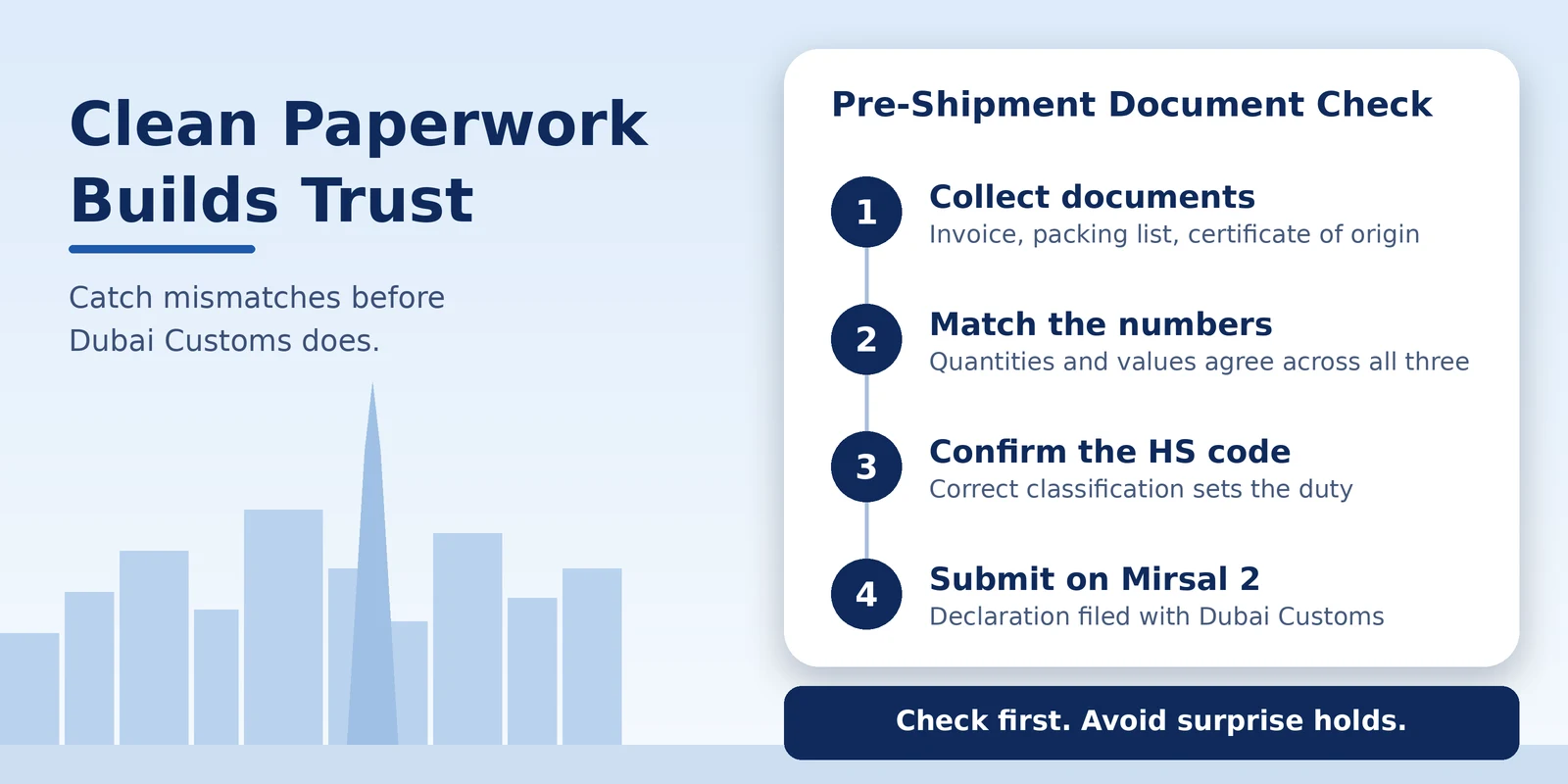
Run a pre-shipment document check
Before submitting, do this:
- Collect the commercial invoice, packing list and certificate of origin where needed.
- Match quantities and values across all three.
- Confirm each HS code (the classification code that sets duty).
- Submit the declaration through Mirsal 2, Dubai Customs’ online system.
Explain AEO if you hold it
The AEO programme is a federal, voluntary scheme built on the World Customs Organization’s SAFE framework. It flags traders as trusted and gives benefits like faster clearance and a dedicated account manager. Mention it only if you’re certified. A claim you can’t prove costs more trust than silence.
Warn customers about classic delay triggers
| Trigger | Root cause | Proactive fix |
|---|---|---|
| Value mismatch | Invoice and packing list prepared by different people | Ask the supplier to issue both together |
| Wrong HS code | Supplier guesses the category | Confirm the code before booking |
| Missing certificate | Nobody owns the checklist | Name one person to chase documents |
Picture a furniture importer whose container is held because the invoice says 400 units and the packing list says 380. Nobody lied. Two suppliers typed on different days. A provider who ran the pre-shipment check fixes it in an afternoon. One who didn’t spends days on calls while storage charges build. Customers remember which team they dealt with.
Send customers this checklist before booking, not after the hold appears.
Give Visibility Before They Ask
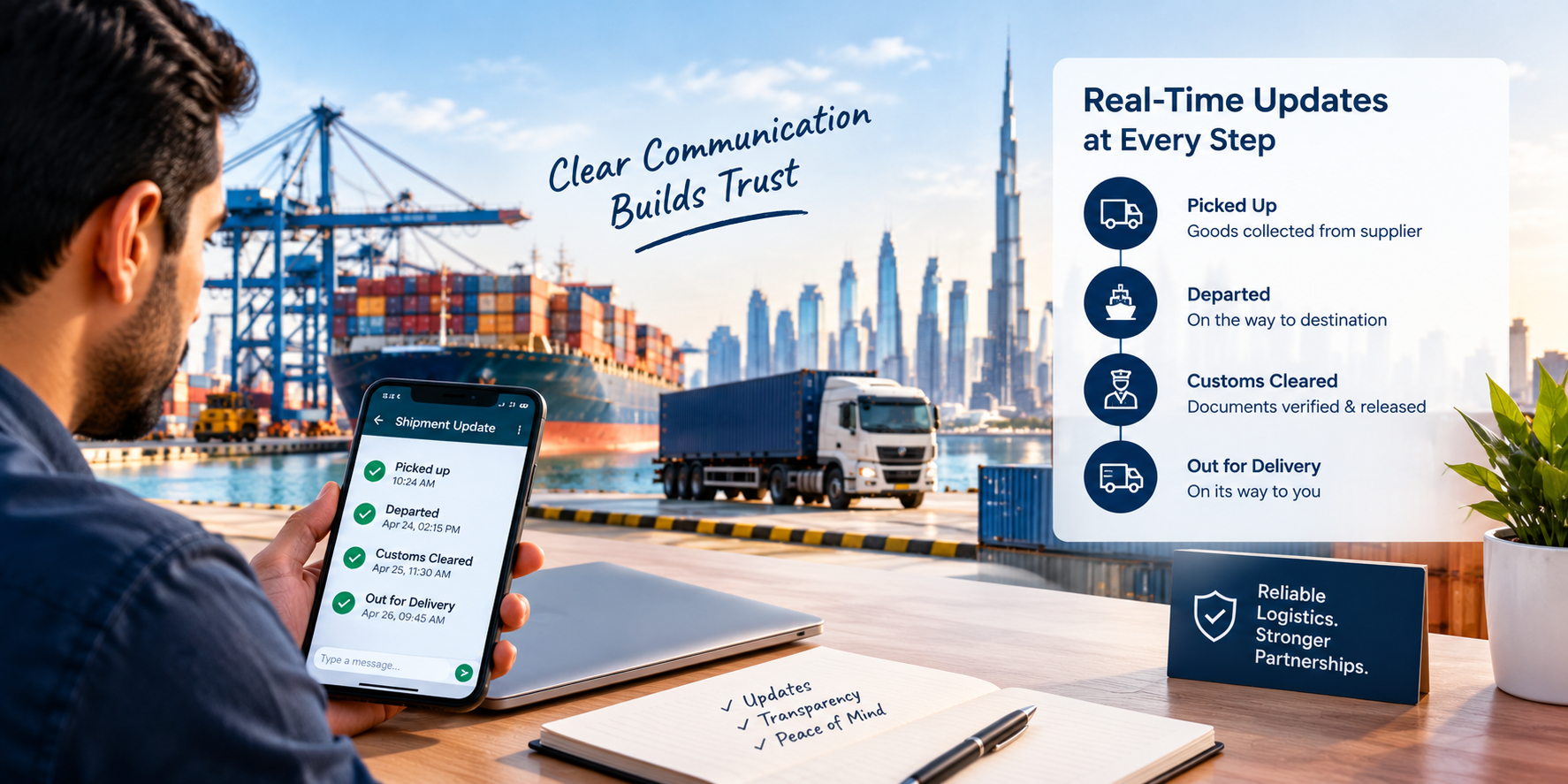
Share milestone updates
Research on logistics outsourcing found that information sharing and reputation are key drivers of customer trust. Send updates at fixed milestones: picked up, departed, declaration submitted, cleared, out for delivery. A tracking link or WhatsApp message works.
Assign one named contact
Give each account one person with a direct number. And make sure they can verify you exist: keep your business name, address and contact details identical everywhere you appear, including listings like addressguru UAE. Inconsistent details make a new customer wonder who they’re dealing with.
Deliver bad news early, in four lines
Use this format: what happened, why, new ETA, what you’re doing about it. Early honesty beats a perfect record you can’t back up.
Put Liability and Data in Writing
Know what your contract can’t say
Under the UAE Commercial Transactions Law, a clause denying all liability for transit damage is void. Delay exclusions can stand, but only in writing and clearly shown on a printed form.
| Clause | Status | Better approach |
|---|---|---|
| No liability for damage in transit | Void | Use declared value and insurance instead |
| No liability for delay | Allowed if clear, in writing | Print it plainly on the form |
| Vague reasonable efforts wording | Invites disputes | Define timelines per stage |
Even a liability cap needs care. The Civil Transactions Law voids clauses that limit liability for gross negligence or fraud, so have a lawyer review yours.
Declare value and document condition
Where the shipper declares the nature and value of goods in the transport document, the carrier is liable up to that amount. So add a declared value field to your booking form and offer cargo insurance alongside it.
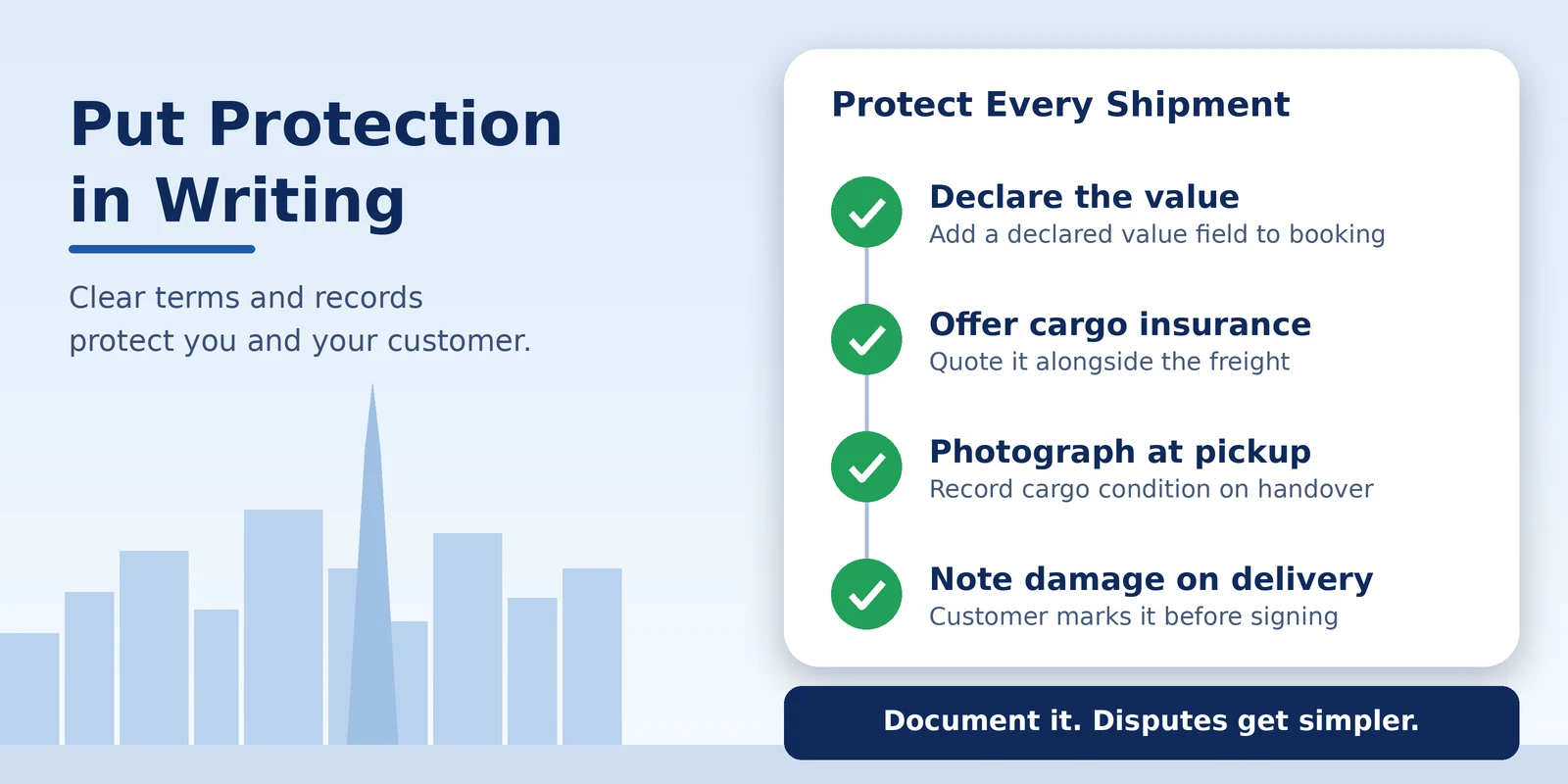
Document condition too. A carrier who accepts goods without reservations is presumed to have received them in good condition. Photograph cargo at pickup. And tell customers to note visible damage on the delivery note, because receiving goods and paying freight can end claims for apparent damage.
State whether you act as an agent or a principal carrier. A forwarder who undertakes the carriage itself carries carrier liability.
Protect their data
Customer data is covered by Federal Decree-Law 45 of 2021, which requires consent, security measures and breach notification. Free zones like DIFC and ADGM have their own rules. In practice: collect only what you need, explain its use in a short privacy notice, restrict access, and write a breach response plan before you need one.
Earn the Second Shipment
Offer a defined first shipment
Propose a pilot with clear scope and four measures: on-time pickup, document accuracy, update timeliness, damage-free delivery. It lowers the customer’s risk without you discounting yourself into losses.
| Approach | Cost-to-value | Hidden risk | Scalability |
|---|---|---|---|
| Pilot shipment | Strong, capped exposure | Scope creep if undefined | Repeatable with a template |
| Price discount | Weak, attracts bargain hunters | Resets expectations permanently | Poor, margins shrink |
| Reference call | Strong if the client agrees | Only works with real clients | Limited by willing references |
Use proof customers can check
Share specific outcomes, with permission: “cleared in two days after fixing an HS code mismatch” beats “great service.”
Review the first shipment together
Book a 15-minute call after delivery. Ask what was unclear, what felt slow and what they’d change. Log the answers and fix them before shipment two.
The Bottom Line
Trust in Dubai logistics isn’t a slogan. It’s licence checks, honest pricing, clean customs paperwork, early updates and contracts that hold up.
Start this week: put your licence and customs code on your quote template, write the “what changes the price” sheet, and set up milestone updates. Do those well and shipment one becomes shipment ten.