

You’ve already told your mother the majlis will face the garden. You’ve shown the kids which window is theirs. Then the email lands: “Additional fee – revised drawings.”
That drop in your stomach isn’t really about money. It’s about being the last to know.
Here’s the good news. Unexpected design costs are rarely random. They come from the same four gaps every time, and you can close all four before you sign anything.
Why Design Costs Creep Up After You Sign
Most people compare the headline fee. Almost nobody compares what the fee actually buys. That’s where hidden architect fees are born.
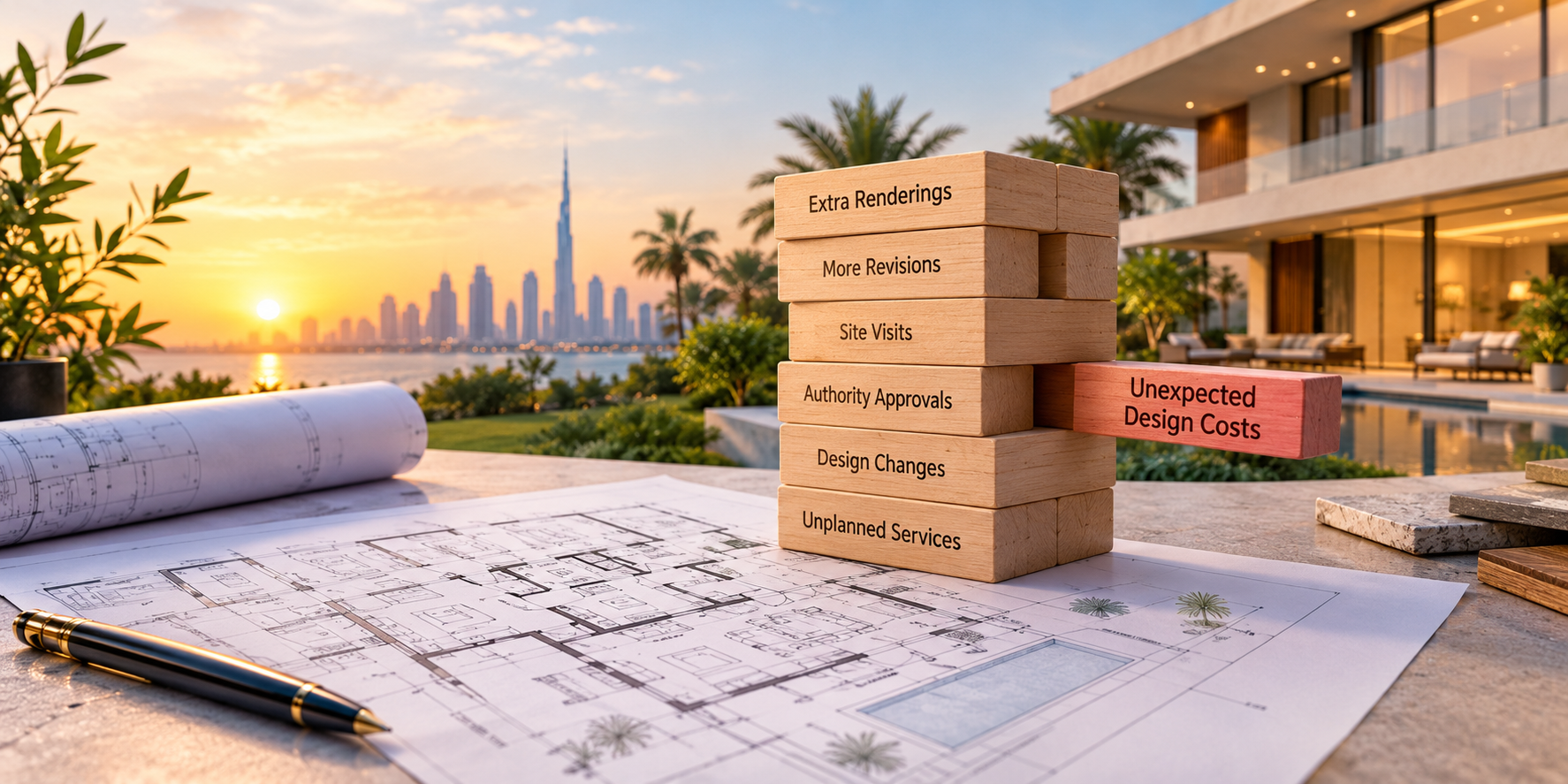
| Gap | What it looks like | Why it hurts |
|---|---|---|
| Vague scope | “Full design” with no deliverables list | Anything unlisted becomes “extra” |
| Unpriced extras | Renderings, models, extra meetings | Billed after the work is done |
| Loose revisions | “A few tweaks” with no cap | Every tweak restarts the clock |
| Silent changes | Verbal decisions on site | Nobody can prove who approved what |
A low fee can also be a narrow fee. Industry guides commonly quote 5–8% of construction value for full-scope UAE architecture fees, with the percentage falling as projects get bigger. Bundle in structural, MEP, interiors and project management, and one guide puts total consultant fees at 10–15% on a luxury villa. These are market figures, not an official tariff, so use them as a benchmark. Two firms quoting different percentages may be pricing completely different jobs.
Get Four Things in Writing Before You Sign
International best practice, including the AIA’s owner-architect agreement guidance, says every agreement should spell out your objectives, the scope of work and deliverables, the fee and payment timing, and the schedule.
In the UAE, add a fifth: who is the registered consultant legally submitting your drawings? In Dubai, Dubai Municipality approval needs a DM-registered architect or consultant to lodge the submission, with structural drawings stamped by a separately licensed engineer. Abu Dhabi and the northern emirates run their own consultant registers. If your designer isn’t registered, you’ll pay a second firm to submit. That’s a classic surprise.
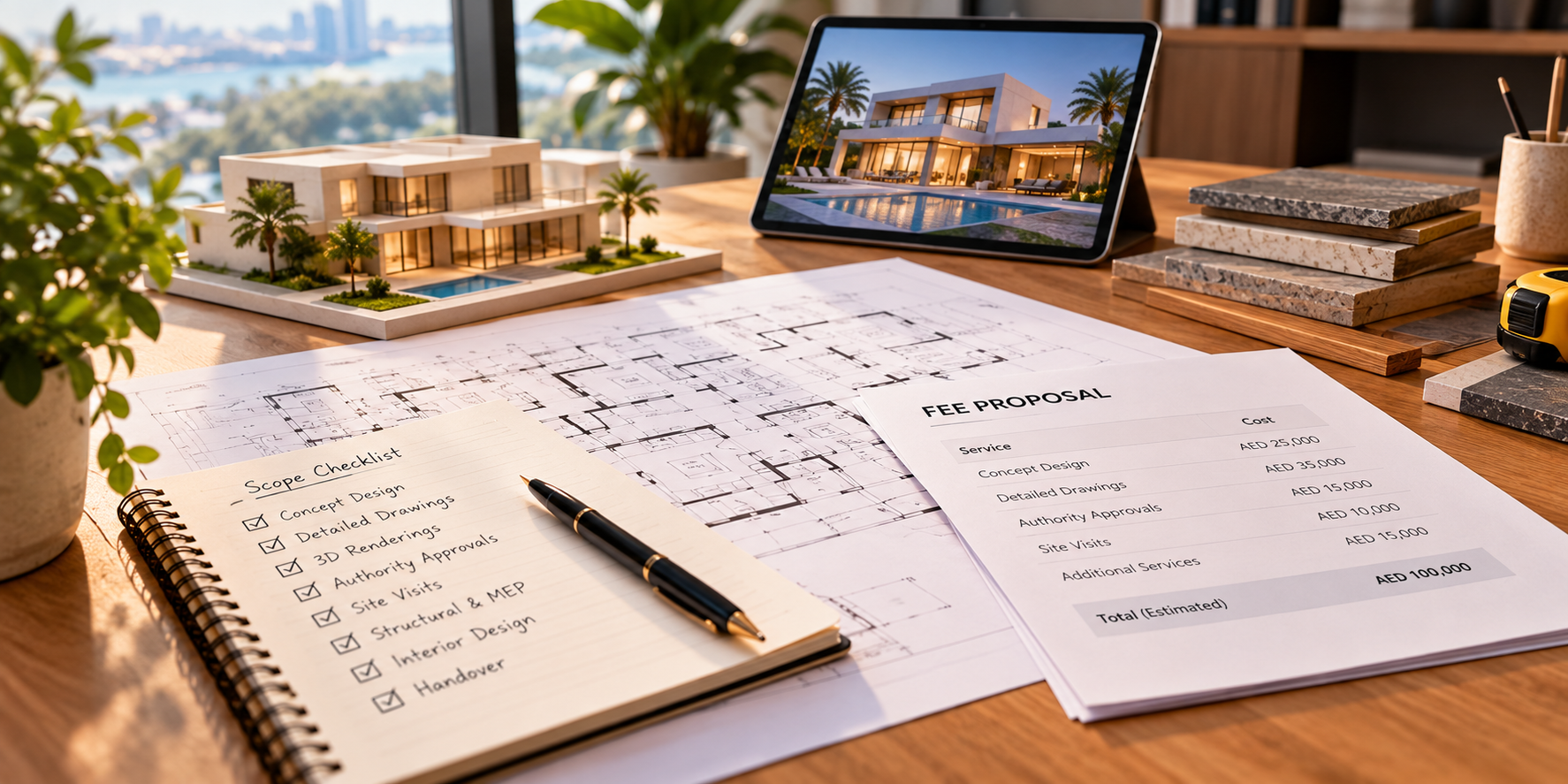
How to do it: ask for a one-page scope map. List every stage (concept, drawings, authority approvals, tender support, site visits, handover) and write “included” or “chargeable” beside each. Then check the firm’s registration with the relevant municipality before paying a deposit.
Pick the Fee Model That Matches Your Risk
The fee model decides where surprises show up. Know it before you negotiate.
| Model | Cost-to-value | Hidden risk | Best for | Common misconception |
|---|---|---|---|---|
| Percentage of construction cost | Fair when scope is large and evolving | Fee rises when your build cost rises | Full-service villas and buildings | A higher percentage means better service |
| Fixed lump sum | Strong, if the scope is tight | A narrow scope hides extras | Clear, smaller projects | Fixed means final |
| Hourly or time-based | Good for small, uncertain jobs | Open-ended, no ceiling | Advice, feasibility, small fixes | Hourly is always cheaper |
How to protect yourself: ask for a not-to-exceed cap on any hourly work. Ask for a stage-wise payment schedule (a set share at concept, submission and approval) so you never pay far ahead of progress. On a fixed fee, attach the scope map to the contract. On a percentage fee, ask whether it applies to the estimated or the final construction cost.
Ask for the Exclusion List, Not Just the Inclusion List
Here’s the tip most clients never try. Quotes show what’s in. Ask what’s out.
| Item | Ask this | The usual trap |
|---|---|---|
| Design options | How many concepts are included? | Option four is billed |
| Revisions | How many rounds, and what’s the rate after? | “Tweaks” turn into invoices |
| 3D views and models | Included or chargeable? | Billed per image |
| Authority approvals | Who submits, who pays follow-ups? | Resubmissions billed separately |
| Structural and MEP | Coordination in the fee? | Separate engineer, separate quote |
| Site visits | How many, any travel charges? | Visits beyond the cap cost extra |
| Interiors, landscape, signage | Included? | Usually separate services |
AIA guidance flags many of these as services owners wrongly assume the base fee covers. Ask for the rate on each chargeable item now, while you still have bargaining power.
Put a Brake on Revisions With the Three-Gate System
Changing your mind isn’t the problem. Changing it silently is. Design revisions are normal. Surprise invoices for them shouldn’t be.
| Gate | The rule | What you get |
|---|---|---|
| Scope gate | Don’t sign until scope, exclusions and fee basis are written | Signed scope map |
| Change gate | Every new request gets a price and time impact first | Signed change note |
| Construction gate | No site change to approved drawings without both sides agreeing | Revision log entry |
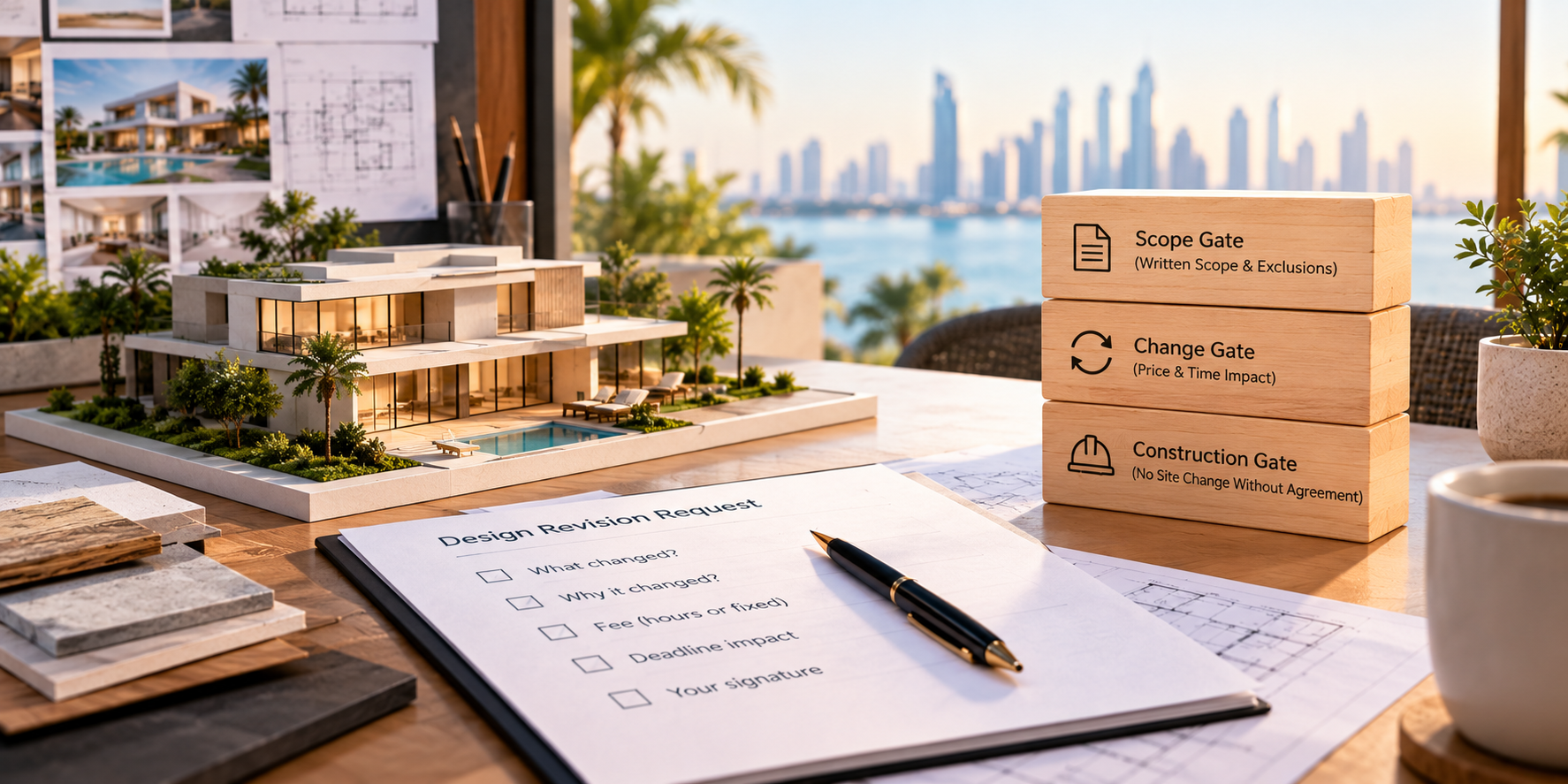
A valid change note has five lines: what changed, why, the fee (hours or fixed), the deadline impact, and your signature. Send it by email and reply “approved” so there’s a timestamp. The rule is simple: no written note, no new charge. It protects the architect too, because nobody wants to work for free.
Freeze the design before tendering. A late change doesn’t just cost design hours. It reprices contractor work, delays material orders and can trigger a fresh submission to the authority.
Compare Firms Side by Side With AddressGuru UAE
You can’t compare quotes if you only know the two firms your cousin mentioned. AddressGuru UAE is a business directory that lists multiple businesses on its website, so you can look up an architecture firm in the UAE in one place, shortlist three and note which emirate each one works in. Send all three the same brief and the same questions (they’re below). Same inputs, same format, quotes you can compare line by line.
What Can Go Wrong, and the Fix
| Risk | Root cause | Proactive fix |
|---|---|---|
| No written agreement | Verbal “we’ll sort it out” | Sign a contract before any drawing starts |
| Authority rejects the design | Concept ignores plot or code rules | Ask for the firm’s rejection history; tie payments to stages |
| A second firm is needed | Designer isn’t registered or multidisciplinary | Confirm who handles structural and MEP, and who signs |
A handshake won’t protect you. In a 2010 Dubai Court of Cassation ruling reported by Al Tamimi, an owner with no written agreement still had to pay the consulting engineer, with the court looking at the parties’ intentions and using Dubai Municipality’s standard agreement as a guide. It’s an older case, but the lesson holds: ambiguity gets expensive.
Misconception: “The design fee is my project cost.” It’s one slice. Late changes ripple into contractor pricing, procurement and approvals. Keep a contingency, and ask your architect to flag anything that touches cost or schedule before acting on it.
Know Your Rights Under UAE Consumer Protection Law
Federal Law No. 15 of 2020 on Consumer Protection gives consumers the right to obtain goods and services at the declared price, and requires a dated invoice showing that price. Its executive regulations add that when a service is delivered in phases, the supplier must give you a payment schedule tied to each phase. That’s one more reason to insist on stage-wise payments in writing. Whether the law covers your exact contract depends on the details, so ask a UAE lawyer if you’re unsure.
Keep a Paper Trail From Day One
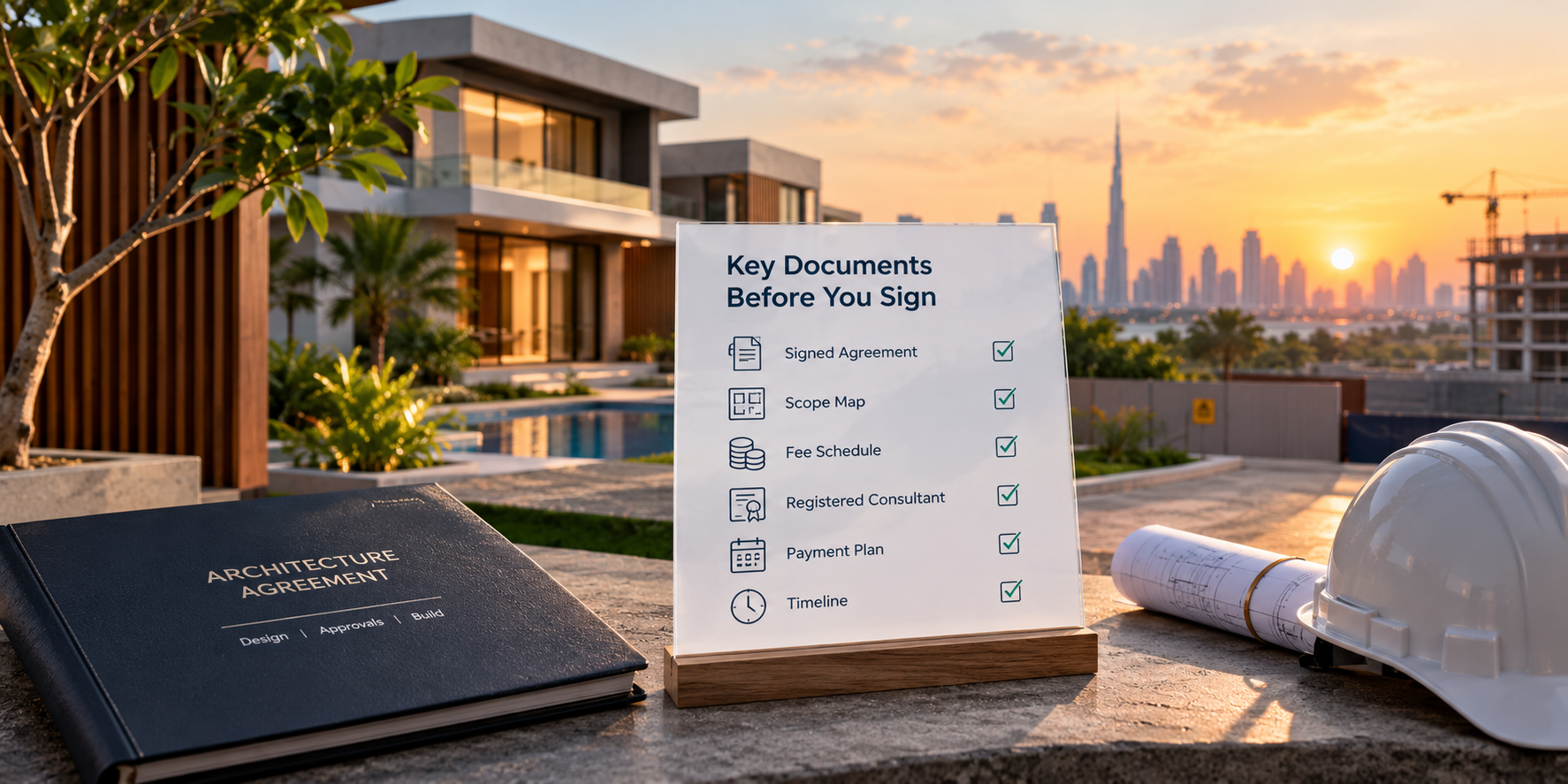
Start one shared folder: signed agreement, scope map, fee schedule, approved drawings, revision log, signed change notes, site-visit records and every invoice. After each call, email two lines: “As discussed, we’re moving the kitchen. Please confirm the fee and timing.” It takes 30 seconds and gives you a dated record.
10 Questions to Ask Before You Sign
- What exactly is in the base fee?
- What’s explicitly excluded?
- How many design revisions are included?
- Are 3D views and models chargeable?
- Who handles approvals, and is that fee included?
- How many site visits are included?
- What’s the rate for additional services?
- Will every extra need my written approval first?
- How are changes to approved drawings documented?
- What happens if I stop the project midway?
The Takeaway
Don’t try to dodge every fee. Make every foreseeable fee visible, priced and approved before work begins. Compare the total cost of certainty, not the cost of the first invoice. Do that, and the next email about your majlis will be the one with the final drawings attached.